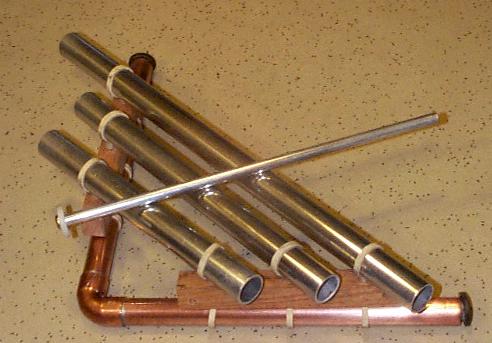
At SANAE we lacked a civilized way to announce dinner, so I decided to build a dinner chime. The base is two pieces of plumbing copper tube, soldered into a standard 90° elbow. The bars are pieces that broke off the riometer antenna, cut to ring at pitch intervals approximating that of a major chord. The wooden carrier beams are pieces of scrap hardwood. The rubber mountings are ordinary office-grade rubber bands, kept from contact with the carrier by small aluminium rings, cut from the broken-off tip of a radar antenna. The stem of the striker is another piece of radar antenna tip, and the head a disk of polypropylene, screwed into a plug of epoxy putty. This disk later worked loose, and was replaced by a hardwood ball.
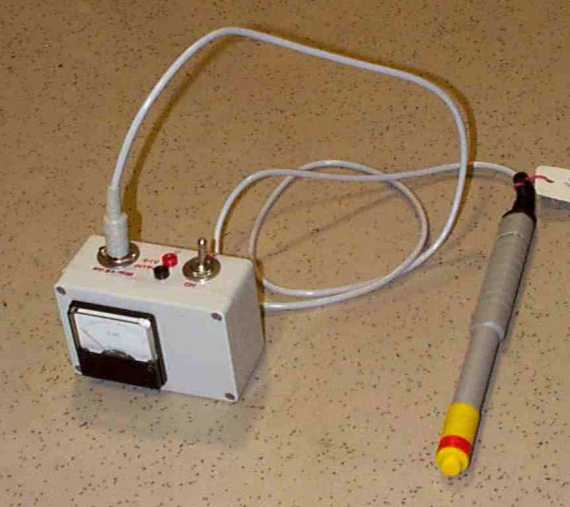
In Antarctica, the air is very dry. The relative humidity in of the atmosphere is between 30% and 60%. When this air is heated to comfortable living temperatures, the relative humidity drops to below 5%, drier than even the driest highveld winter air. To counteract this, SANAE IV has humidifiers as part of the air conditioning system, but it is very difficult to know whether it works or not. There is a psychrometer available, but using it is not particularly simple and convenient. Ryan Earle and I concocted this humidity meter; Ryan did the mechanical work on the box, I did the electricity. The probe is a standard Vaisala temperature and humidity probe, borrowed from the Weather Bureau. When powered, it gives a 0 – 1 V output, proportional to the relative humidity. A 5-pin DIN plug and socket connects the probe to the box. A panel-mount galvanometer were supplied with the necessary series resistor, to give a full-scale deflection of 100%RH. The whole is powered by a 9V battery. With this, the SANAE engineers now have a portable way of determining relative humidity in the base.
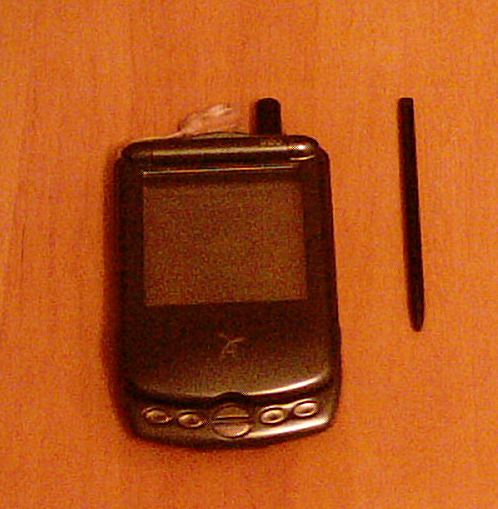
I bought a second-hand Handspring Treo 180 PDA/Phone combination for a good price, but it
came without a stylus. One can buy new or aftermarket styli, but they are quite expensive, and
disproportionately so for the price I paid for my phone. I therefore made one myself. I bougth
a length of 4 mm carbon-fibre round rod at a hobby shop, (it is used as stringers in flying model
aircraft) and sharpened the one end with a pencil sharpener. With a trianglular file I cut it to
length, gave it a smooth rounded point, smoothed all the edges, and made a catch-groove round the back end.
After some use I noticed that the stylus scratched the screen, so I coated the tip with epoxy adhesive.
Carbon fibre is light and strong, and the epoxy tip surface superior in feel to the supplied stylus. The
drawback of the one-piece stylus is that it does not have the built-in reset pin.